


Key Takeaways
- Signal is Momentum's productized delivery framework for getting wearable health intelligence into health apps
- Three defined phases: Blueprint, Foundation, and Intelligent, from scoping to live AI coaching in weeks
- Built on Open Wearables, our MIT-licensed open source platform: self-hosted, zero per-user fees, owned by the client
- Signal replaces months of custom integration work with a repeatable framework built across years of healthtech delivery
- Signal is for health and fitness apps, longevity platforms, AI coaching startups, and digital therapeutics that need wearable intelligence without building the data layer from scratch
Is Your HealthTech Product Built for Success in Digital Health?
.avif)
Introduction
Wearable health data has been available for years. Apple Health, Garmin, Whoop, Polar, the devices are in users' hands. The problem has never been access to the data. The problem is turning it into something a product can act on.
Most health app teams spend months on integration work before they can build a single health feature. OAuth flows, data normalization, provider-specific schemas, per-user API fees that compound at scale. By the time the data layer is stable, the roadmap has slipped and the budget is gone.
Today we are introducing Signal: Momentum's delivery framework for wearable health intelligence. Signal gets health scores, AI coaching, and personalized recommendations into your product in weeks. We handle the integrations, data model, and intelligence layer. Your team ships the experience.
What building wearable health features actually looks like
Before Signal, health teams building wearable integration into a product face three layers of work that consistently exceed initial estimates.
The first is provider integration. Each wearable has a different API, a different OAuth flow, a different data schema. Apple Health works differently from Garmin, Whoop has different rate limits from Polar, and every provider addition multiplies the maintenance surface. Teams that tackle wearable integrations from scratch regularly discover the real cost of wearables integration only after they are six months in and deeper than planned.
The second is health scoring. Raw wearable data, heart rate samples, sleep stage transitions, HRV readings, means nothing to users in its raw form. Turning it into a sleep quality score, a recovery readiness metric, or a training load index requires clinical logic, algorithm tuning, and population-specific calibration. This work is not a one-time build. Algorithms need ongoing validation as the user base grows and new devices enter the mix.
The third is intelligence. Health scores alone are not enough. Users need context, recommendations, and coaching that adapts to them over time. That requires an AI reasoning layer connected to the health data, configured for the product's domain, and capable of cross-score reasoning across sleep, recovery, activity, and stress. Without it, users see numbers. With it, they know what to do.
SaaS APIs solve part of the first problem and introduce per-user fees that scale with the product. They offer no scoring layer and no intelligence layer. Signal solves all three.
What Signal delivers
Signal is a delivery framework, not a consulting engagement. It has defined phases, defined deliverables at each phase, and a defined outcome: wearable health intelligence, live in the product, in weeks.
After Signal, users connect a device and immediately see a sleep quality score, a recovery readiness score, and personalized recommendations for the day. They stop staring at raw numbers. The product tells them what to do next, not just what happened. That shift, from data display to actionable intelligence, is what keeps users coming back.
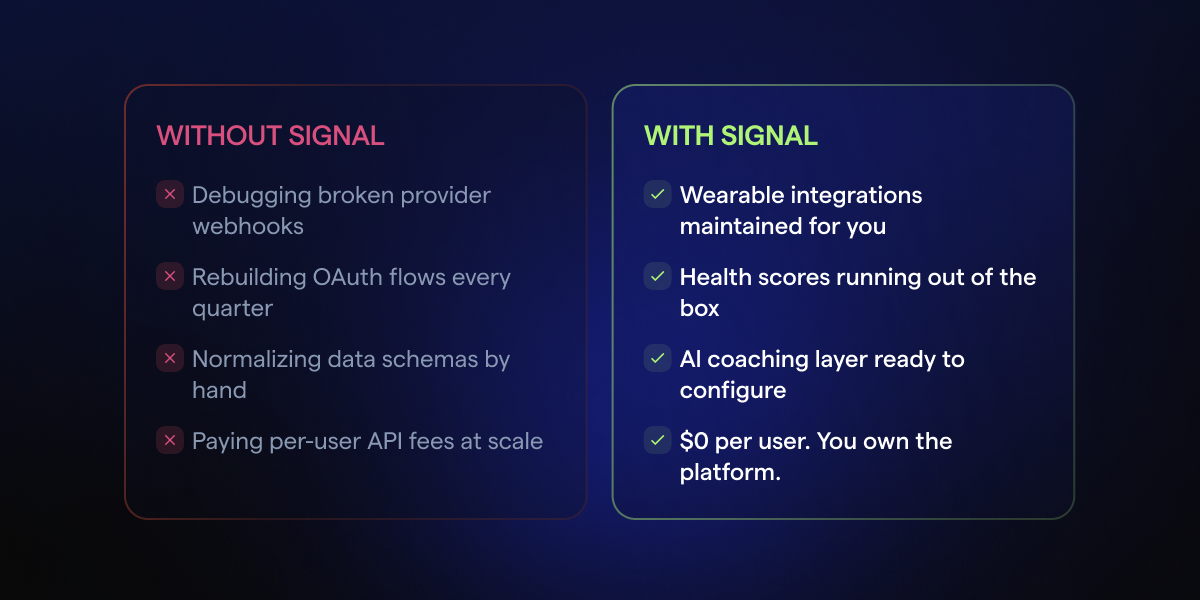
For the product team, the difference is equally concrete. The engineering team stops maintaining OAuth flows and debugging broken provider webhooks. Health scores run out of the box, tuned to the product's population. The AI coaching layer is configured and live. The platform runs on the client's own infrastructure, with zero per-user fees and no vendor dependency.
Signal runs on Open Wearables, Momentum's open source platform for wearable health data. MIT licensed, self-hosted, zero per-user fees. Clients own the code from day one. There are no black boxes, no vendor lock-in, and no ongoing license fees tied to user growth.
Three phases, clear outcomes
Blueprint
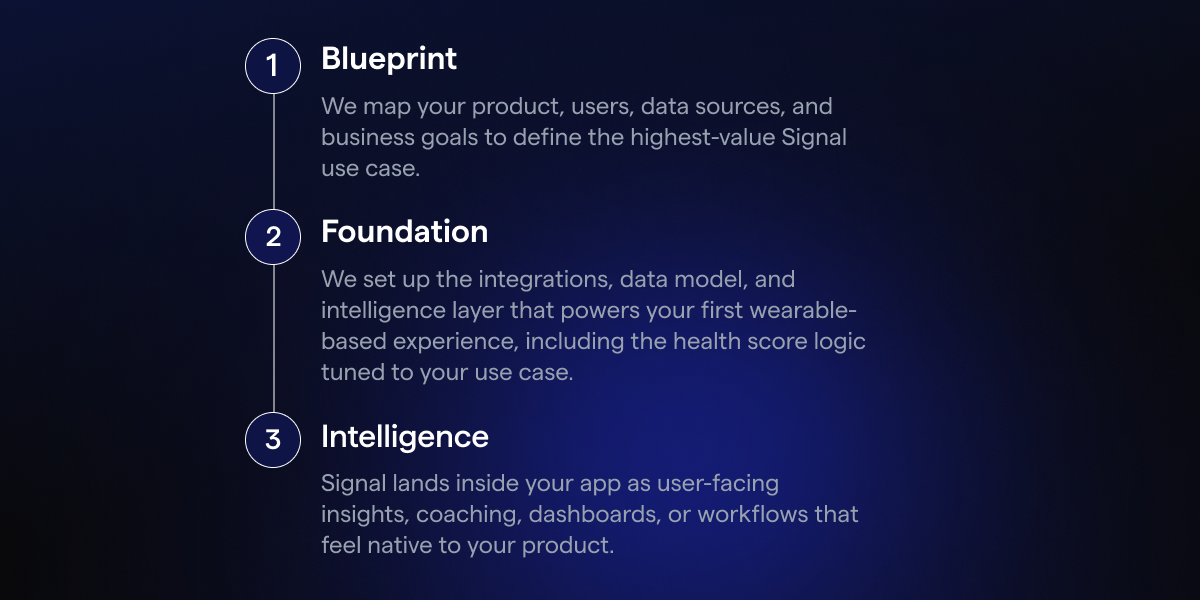
Blueprint is the scoping phase. We map the product, the users, and the wearable data sources to define the highest-value Signal use case. This phase produces an architecture diagram showing where Open Wearables fits in the client's stack, a provider coverage matrix, and a cost model comparing current infrastructure spend against what open source deployment looks like.
Blueprint clients leave with a concrete implementation plan. The phase is designed to deliver standalone value. A product team that sees their current API costs modeled against self-hosted infrastructure has the information they need to make a decision, whether or not they continue to Foundation.
Foundation
Foundation deploys Open Wearables on the client's infrastructure and connects wearable providers: Apple Health, Garmin, Whoop, Polar, Suunto, Strava, Samsung Health, Google Health Connect, and more. Health scores are activated and tuned for the client's user population. The data pipeline is integrated with the client's backend.
By the end of Foundation, users can connect a device and see a sleep quality score and a recovery readiness score within minutes. The client owns the platform. Per-user fees are zero.
This is where interest converts to conviction. Teams that watch their users connect a device and receive a health score in real time, built on infrastructure they own, understand what Signal delivers in a way that a scope document cannot convey.
Intelligent
Intelligent activates the AI reasoning layer. The Open Wearables MCP server is integrated with the client's LLM or AI system. Coaching profiles are configured for the client's domain, whether that is fitness, longevity, clinical monitoring, or behavior change. Cross-score reasoning connects trends, anomalies, and correlations across health dimensions. Proactive alerts and personalized recommendations go live.
Building this layer from scratch, after stabilizing the data layer, typically takes another 4 to 8 months.
Learn more about how Signal works at themomentum.ai/signal, or read why we built it this way.
What clients own after Signal
The client owns everything Signal delivers. The Open Wearables platform runs on their infrastructure. The algorithms are auditable. The coaching profiles are configurable. There is no license tied to user count, no API fee per call, and no vendor relationship to maintain.
This is the distinction between Signal and SaaS wearable integration APIs. SaaS APIs sell data access and charge per user. They own the algorithms. When a provider changes their API, the SaaS vendor decides when and how to respond. Clients have no visibility into how health scores are calculated.
Signal delivers health intelligence that lives inside the product, not in someone else's cloud.
Built on Open Wearables
Open Wearables is the open source foundation Signal is built on. MIT licensed, self-hosted, with a growing community of contributors and 1700+ GitHub stars.
Open source is the foundation. Signal is the delivery.
Developers discover Open Wearables, deploy it, and build on it. When they need health intelligence at production scale, with coaching profiles, AI reasoning, and ongoing support, that is when Signal starts.
Start with a Blueprint
The entry point to Signal is a Discovery Workshop: a free, one-day engagement where we map the product, the users, and the best wearable intelligence opportunity. The client leaves with the exact path to ship it.
If you are building a health product and wearable data is still a blocker, start with a Blueprint. Read our statement on why we built Signal this way.


.png)
%201.png)
