

.avif)

Key Takeaways
- In-house integration costs $63K–$138K in year one: developer time is only part of it; HIPAA compliance, legal review, and edge case handling are the silent budget killers.
- SaaS is 3–5x cheaper until you hit ~10,000–20,000 active users: that's the real crossover point where building in-house starts to pay off economically.
- Platform constraints kill timelines: Apple Health requires a native iOS app (no backend API), Garmin has a 2-week partnership approval process, and Fitbit enforces hard rate limits.
- Data normalization is massively underestimated: sleep scores differ across devices, and merging duplicate step counts alone can consume weeks of engineering time.
- Open source shifts the cost structure, it doesn't eliminate it: Open Wearables removes per-user licensing fees but transfers costs to infrastructure ownership and ongoing maintenance.
- The market is consolidating fast: Junction's $18M Series A and LexisNexis acquiring Human API signal enterprise appetite and accelerating vendor maturation.
- AI is the next competitive frontier: the winners won't be whoever pipes data best, but whoever builds AI Health Agents and health ops tooling on top of it.
Is Your HealthTech Product Built for Success in Digital Health?
.avif)
The wearables API cost situation has fundamentally shifted in 2026. What seemed like a straightforward technical challenge (connecting Apple Health, Garmin, and Fitbit data) now reveals health data API pricing variations from $4,800 annually for basic SaaS platforms to $65,000-$140,000 for custom integrations.
For CTOs and technical founders evaluating their options, understanding wearables API comparison options including open source health API solutions has become critical for budget planning and strategic decisions.
Integrating wearables data isn't optional anymore. The real decision is how much you're willing to pay and what control you're willing to give up.
Why Building In-House Costs More Than Most Teams Expect
Most technical teams initially estimate 2-3 weeks for basic wearables integration. Reality consistently proves otherwise. Production-ready multi-device integration typically requires 2-4 months and $65,000-$140,000 in the first year.
The Real Cost Comes From Developer Time, Not APIs
The high health data integration cost isn't just about APIs and infrastructure. It's primarily driven by developer time and complexity that compounds across every platform.
Every Platform Is a Unique Snowflake
Apple Health requires a native iOS app since no backend API exists. You literally cannot access the data any other way. Garmin demands formal partnership applications with 2-week approval cycles. Fitbit limits developers to 150 requests per user per hour. Each platform uses different OAuth flows, data formats, and rate limits.
Platform-by-Platform Development Costs Add Up Fast
At $100,000 annual mid-level developer salary, each platform integration consumes 2-4 weeks of developer time, translating to $3,800-$7,700 per platform just in labor costs. Multiply that across six major platforms and you're looking at $23,000-$46,000 in development time alone.
Data Normalization Becomes Its Own Engineering Project
Sleep scores from Oura, Fitbit, and Garmin use completely different calculation methodologies. Heart rate variability measurements vary between devices. Even basic metrics like "steps" require custom logic to handle overlapping data sources and prevent double-counting.
Edge Cases Consume Disproportionate Engineering Time
Teams commonly spend three weeks or more just figuring out how to merge duplicate step counts when a user wears both an Apple Watch and carries an iPhone. That's roughly $1,800 in developer time for one edge case, and there are dozens of similar scenarios across different device combinations.
Ongoing Maintenance Multiplies Initial Development Costs
APIs change, OAuth tokens expire, rate limits shift, and new devices launch with different data schemas. Teams typically allocate 20-40% of initial development time annually for maintenance. If initial integration cost $50,000 in developer time, expect $10,000-$20,000 annually just to keep integrations working.
Infrastructure and Compliance Costs Add Up
Basic cloud hosting runs $3,000-$12,000 annually. Time-series databases for health data add another $2,000-$8,000. Basic HIPAA compliance implementation costs $10,000-$25,000, with annual maintenance around $3,000-$8,000.
When you factor in developer time ($40,000-$70,000), infrastructure ($5,000-$20,000), basic compliance ($13,000-$33,000), and legal review ($5,000-$15,000), the total first-year expense ranges from $63,000 to $138,000.
.png)
Health Data API Pricing: The Complete 2026 Breakdown
The wearables API market breaks down into two distinct camps: transparent developer-first platforms and opaque enterprise solutions that make you call for pricing.
Terra API Pricing vs Developer-First Alternatives
Terra API pricing leads in market transparency. Their base subscription costs $399/month (annual) or $499/month (monthly) and includes 100,000 credits. Each active user consumes roughly 200 credits monthly, making the effective cost per user wearables integration about $4,800/year for 500 users or $10,800/year for 1,000 users.
Overages cost $0.005 per credit up to 1 million, dropping to $0.003 beyond that threshold. At least you can calculate your costs without a sales call.
Junction (formerly Vital)
Keeps it simple with per-user pricing: $0.50/user/month with a $300 minimum, creating a $3,600 annual floor. Volume discounts kick in above 1,000 users, though you'll need to talk to sales for specific rates. Their unique angle combines wearables with lab testing APIs, which could be valuable if you need both.
Sahha.ai
Significantly undercuts competitors at $99-189/month for up to 1,000 users, then $0.10 per additional user. For teams prioritizing cost over comprehensive device coverage, this represents substantial savings (roughly 75% less than Terra API pricing for comparable usage).
ROOK
Offers a core tier starting around $99/month, but requires additional feature add-ons that can push monthly costs to $499+ for functionality that competitors include by default.
{{lead-magnet-2}}
Enterprise Solutions Require Sales Conversations
Several platforms target enterprise healthcare and insurance markets with custom pricing models. These typically require lengthy sales processes, minimum contract values, and implementation services that add $10,000-$50,000 to initial costs. Premium support increases expenses by 10-20%, and custom integrations cost $5,000-$25,000 each.
If you're a startup or mid-market company, these enterprise-focused platforms probably aren't designed for your use case anyway.
Wearables API Comparison: Technical Reality Check
API limitations often blindside development teams during implementation and significantly impact wearables API cost calculations through increased development time.
Fitbit
Its 150 requests per user per hour makes historical data sync painful for active users. The rate limit is per-user, not per-client, meaning high-engagement apps can throttle quickly. Developers spend additional weeks building queue systems and retry logic to handle these constraints.
Apple Health
Its architecture forces complete rethinking of cloud-first development. All data stays on the device with no backend API access. You must build native iOS applications to read any HealthKit data, then implement secure sync protocols to your servers. This mobile-first requirement can add 2-4 weeks of development time for teams without iOS expertise.
Strava
Maintains the strictest limits: 200 requests per 15 minutes and 2,000 per day, with certain endpoints further restricted. New applications launch in "Single Player Mode" supporting just one athlete until you get Developer Program approval.
Garmin
Requires formal business applications with 2+ business day approval times. Rate limits exist but remain undocumented during evaluation periods. Platform policies for API access can change with little notice, so teams should budget time for renegotiating terms as their integration scales.
Oura
Limits developers to 10 users before requiring company approval, and users must maintain active Oura subscriptions for API access, which complicates consumer apps targeting budget-conscious audiences.
Each of these constraints requires custom handling, error management, and testing scenarios that extend development timelines significantly.
.png)
Why the Math Still Favors SaaS (For Most Teams)
The wearables API cost economics are clear: SaaS platforms cost 3-5x less than in-house builds for the first few years.
A startup with 1,000 active users pays $3,600-$10,800 annually for comprehensive wearables integration versus $63,000-$138,000 in first-year development and infrastructure costs. That's still a significant difference.
The crossover point where building becomes economically attractive typically occurs around 10,000-20,000 active users, assuming $0.50/user/month SaaS pricing. However, most companies that reach this scale often have other engineering priorities that continue to favor specialized platforms.
Think about the opportunity cost: those 2-4 months of engineering time could deliver core product features, AI capabilities, or user experience improvements that directly drive revenue and user retention.
Open Source Health API: The Zero-Cost Alternative
Bridging the Gap Between SaaS and In-House Builds
The gap between SaaS platforms and complex in-house builds has created space for open source health API solutions. Open Wearables provides a self-hosted health data platform with unified APIs for major platforms including Apple Health, Garmin, Fitbit, Oura, Whoop, and Strava.
Why Open Source Changes the Cost Equation
Open source offers compelling advantages over traditional health data aggregation pricing models: no vendor lock-in, transparent data processing, and community-driven improvements. Teams can modify the platform for specific requirements without waiting for vendor roadmaps. Privacy-conscious organizations maintain complete control over sensitive health data.
Heart Monitor, a health app with 90,000 active users, took this route and avoided per-user SaaS fees entirely by self-hosting Open Wearables. See the full breakdown of how they did it.
The Trade-Off: Technical Ownership
The trade-off? You need technical expertise for deployment, monitoring, and maintenance. However, the initial setup typically requires days rather than months, dramatically reducing the developer time investment compared to building from scratch.
Hybrid Architectures for Cost and Coverage Optimization
Hybrid architectures can balance coverage and cost by combining direct integrations for high-volume platforms (Apple Health, Garmin) with SaaS platforms for long-tail devices (Oura, Whoop). This approach optimizes cost per user wearables integration while maintaining strategic flexibility.
.png)
Market Consolidation Changes the Competitive Field
Recent funding and acquisitions signal market maturation in the wearables API space. Junction raised $18M Series A in March 2025, while smaller players like Spike secured $3.5M seed funding. LexisNexis's acquisition of Human API demonstrates interest from non-endemic buyers seeking health data capabilities.
The market segments clearly:
- Developer-focused fitness/wellness: Terra API, Junction, Sahha
- European market: Thryve (Berlin-based, GDPR-focused)
- Open source: Open Wearables, NiMBaLWear
- Enterprise healthcare: Custom solutions with sales-driven pricing
AI enhancement represents the next competitive battleground. Terra launched "Tyran" AI Health Agents, and Spike introduced "Health Ops" for AI-powered health agents. The market is shifting from pure data aggregation toward interpretive insights.
This matters because raw data is becoming commoditized. The value is moving to interpretation and intelligence.
{{lead-magnet}}
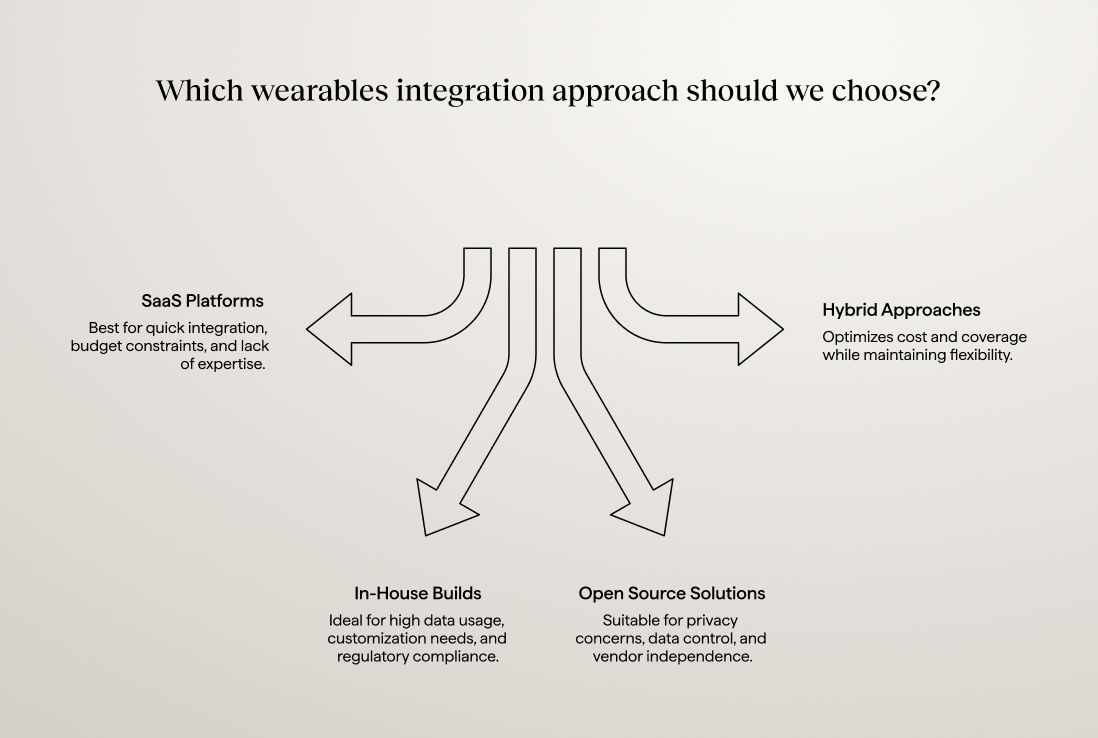
How to Choose the Right Wearables Integration Approach
Understanding your specific needs makes wearables API comparison decisions easier.
Choose SaaS platforms if:
- Your budget is under $500K runway
- You need 100+ device integrations quickly
- You lack dedicated healthcare engineering expertise
- You prioritize speed-to-market over vendor independence
Consider in-house builds if:
- You have 10,000+ active users with high data usage
- Specific customization requirements demand full control
- Regulatory constraints prevent vendor dependencies
- Your engineering team has available capacity and expertise
Explore open source health API solutions if:
- Privacy or security requires complete data control
- Your technical team can handle deployment and maintenance
- Vendor lock-in is strategically unacceptable
- Budget constraints eliminate SaaS options
Hybrid approaches work when:
- You're optimizing per-user economics at scale
- You need maximum device coverage with cost control
- You're building strategic moats while maintaining flexibility
Looking for Affordable Wearables Integration? Consider Open Source
For teams frustrated with enterprise health data aggregation pricing or escalating per-user SaaS fees, Open Wearables provides a compelling self-hosted health data platform alternative. Unlike proprietary solutions with monthly charges, this open source health API offers:
- Zero per-user costs after initial setup
- Complete data ownership and control
- Community-driven feature development
- Transparent architecture vs black-box solutions
The platform handles the complex integration work while giving you full control over your health data infrastructure. Teams can deploy it in days rather than months and modify it for specific requirements without vendor dependencies.
See how different teams are applying this approach across 8 real-world wearable integration use cases.
The Bottom Line on Wearables API Cost
For most organizations, the wearables API cost analysis favors specialized platforms. $4,800-$15,000 annual costs beat $63,000-$138,000 first-year development and infrastructure expenses by 3-5x while delivering faster time-to-market and reduced technical risk.
However, the strategic calculus extends beyond pure cost comparison. Vendor lock-in, data control, customization requirements, and long-term scaling economics all factor into the decision. Teams should evaluate total cost of ownership across a 3-5 year horizon, including potential migration costs and vendor risk assessment.
The market trajectory points toward continued consolidation and AI enhancement. Whether building or buying, plan for platform evolution, contractual flexibility, and eventual migration paths as your requirements and scale evolve.
For most CTOs, wearables integration is already worth the investment. What matters is which approach aligns best with your organization's technical capabilities, budget constraints, and strategic priorities.
And increasingly, that answer is pointing toward specialized platforms rather than reinventing the wheel in-house.
Momentum's wearables integration service is one such option, built on Open Wearables.
%201.png)


.avif)
.avif)
.png)


.avif)