



Key Takeaways
- Wearable integration isn't just about API connections, it's about normalizing messy device data into clinically meaningful insights
- The Google Fit APIs sunset on June 30, 2025 made Health Connect expertise non-negotiable for Android development
- The gap between "we can integrate HealthKit" and production-grade wearable data pipelines is wider than most agencies admit
- Budget-conscious teams can find enterprise-grade compliance at 40-60% lower costs with Eastern European specialists
- The best wearable integration partners understand both the technical SDK maze and the clinical context that makes the data useful
Is Your HealthTech Product Built for Success in Digital Health?
.avif)
The mobile health app development market has evolved beyond simple fitness tracking. Modern healthcare applications require sophisticated wearable data integration spanning Apple HealthKit, Google Health Connect, proprietary SDKs, and medical-grade sensors. With wearables generating millions of data points daily and Google Fit APIs having sunset in mid-2025, choosing the right development partner has never been more critical.
This curated list identifies leading companies that combine proven healthcare development experience with demonstrable wearable integration capabilities. The mHealth app market is projected to reach $88.7 billion by 2032, and 80% of US hospitals now use wearables for remote patient monitoring. This isn't experimental technology, it's essential infrastructure.
Selection Methodology: How We Evaluated Mobile Health App Developers
Companies were evaluated based on five rigorous criteria:
- Documented wearable integration projects across multiple device ecosystems
- Healthcare industry focus and compliance expertise (HIPAA, FDA, ISO 13485)
- Independent verification through Clutch/GoodFirms ratings and client testimonials
- Notable client case studies demonstrating production deployments
- Evidence of continued recent operations and active healthcare engagement
We prioritized partners who understand that wearable integration encompasses data pipelines, normalization challenges, clinical context, regulatory requirements, and operational realities, not just basic API calls.
Here's who we'd actually consider working with.
For teams weighing this decision, our own wearables integration work shows what production-grade wearable data pipelines look like once they move past a proof of concept.
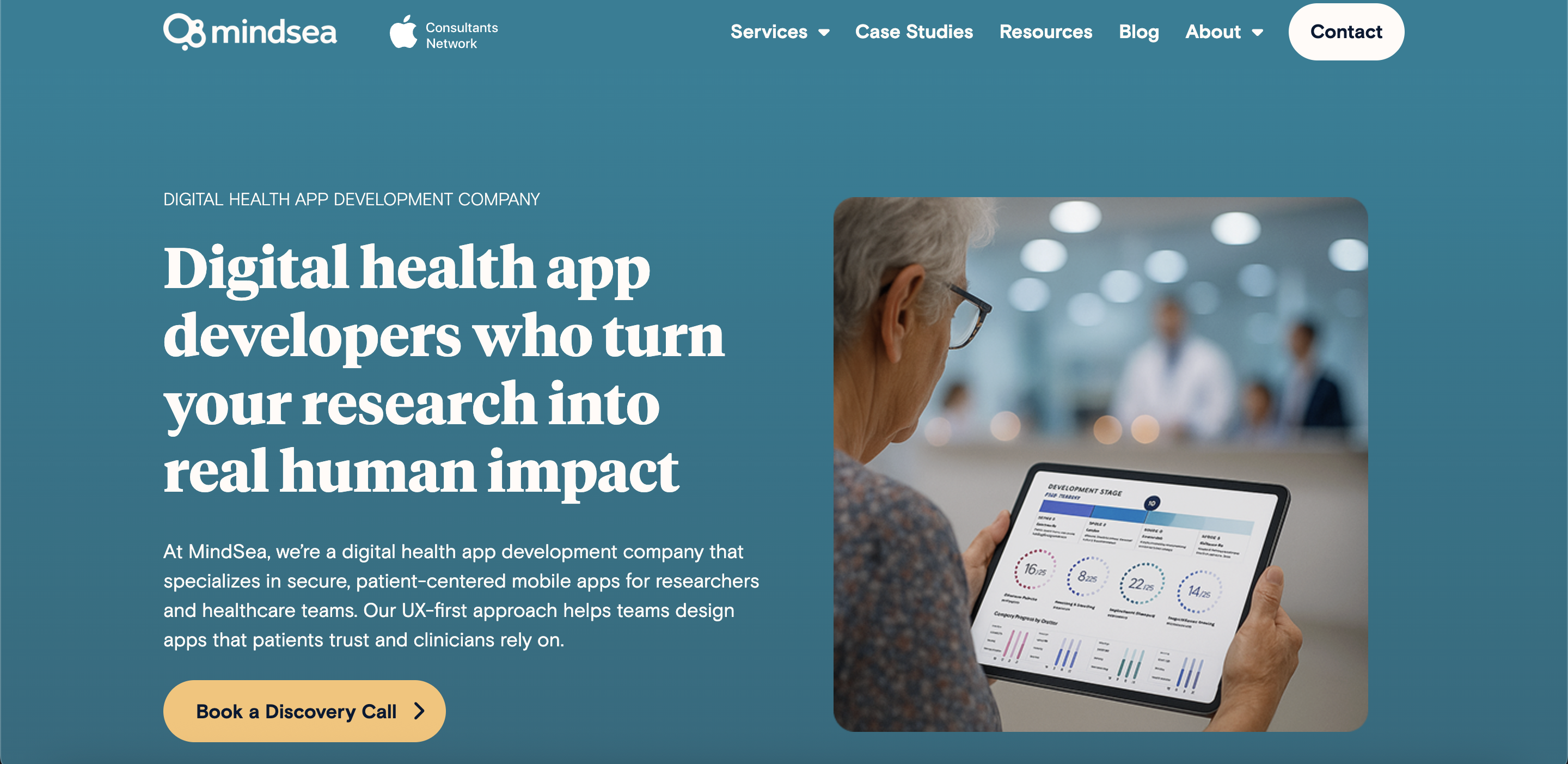
1. MindSea: Canada's mobile-first health specialist
Headquarters: Halifax, Nova Scotia, Canada
Company Size: Mid-size agency | Founded: 2007
Core Services: MindSea is a mobile-first health product development company. Their singular focus on mobile health experiences (not enterprise ERP or e-commerce) means deeper understanding of mobile-native patterns and faster iteration cycles than broader digital agencies can match.
Wearable Integration Expertise:
Strong Apple ecosystem expertise with deep HealthKit implementations, watchOS development capabilities, and fitness tracker data synchronization. They excel at health data visualization that makes sense to end users, understanding nuances of background data collection, battery optimization for continuous monitoring, and UX patterns that maintain user engagement.
Notable HealthTech Projects:
- CHARM-COPD: A remote patient monitoring platform that doesn't just collect data but helps clinicians detect and predict COPD exacerbations before they become emergencies.
- Halterix: Motion recognition via smartwatch that evaluates patient exercise data and shares it with practitioners. Real-time biomechanical assessment through consumer wearables.
- The BEAM Program (University of Manitoba): Digital mental health support with family-wide tracking.
Why They Made This List: Pure mobile focus. While competitors offer full-stack enterprise services, MindSea's singular expertise in mobile health product development delivers better mobile experiences. They stay laser-focused on the mobile product without getting distracted by backend sprawl.
Best Fit For: Consumer wellness apps, patient-facing monitoring tools, startups needing beautiful mobile experiences with seamless wearable integration. Less ideal for complex enterprise EHR integrations.

2. ScienceSoft: Enterprise healthcare with three decades of delivery
Headquarters: McKinney, Texas, USA (global offices)
Company Size: 750+ IT professionals | Founded: 1989 (healthcare IT since 2005)
Core Services: ScienceSoft provides full lifecycle healthcare IT solutions with particular strength in FDA-cleared medical device software. When you need not just an app but supporting infrastructure, regulatory submission support, and long-term maintenance, their breadth becomes relevant.
Wearable Integration Expertise:
Comprehensive technical stack covering Apple HealthKit, Google Fit/Health Connect, BLE connectivity, and custom motion capture algorithms. Implementation of FHIR, HL7, and DICOM standards for clinical data interoperability. Cloud infrastructures optimized for continuous wearable data streams handling millions of data points daily.
Notable HealthTech Projects:
- AKLOS Health: Custom motion capture IoT rehabilitation platform measuring joint range-of-motion. Medical-grade accuracy through consumer device frameworks.
- VitalOp Wellness: Physiotherapy platform using wearable sensors to measure joint motion range and assess therapy progress.
- bioAffinity Technologies: Desktop app for lung cancer detection with diagnostic reports based on analysis of flow cytometry data
Recognition: Triple ISO certification (ISO 13485, ISO 27001, ISO 9001). Named in Healthcare Technology Report's Top 25 Healthcare Software Companies of 2025.
Why They Made This List: Structure and regulatory experience. If you're building something requiring FDA clearance, CE marking, or operating at enterprise scale with serious liability exposure, ScienceSoft brings process maturity and documentation discipline.
Best Fit For: Medical device software, enterprise healthcare systems, products requiring FDA/CE clearance. Too heavy for early-stage startups validating market fit.
3. Momentum: Healthcare-only agency pioneering open wearables infrastructure
Headquarters: Wrocław, Poland
Company Size: 50-150 specialists | Founded: 2016 (rebranded from Applover in 2024)
What Makes Momentum Different: Momentum isn't a digital agency that does healthcare projects alongside e-commerce and fintech. We walked away from other verticals in 2020 to specialize exclusively in healthcare AI, mobile health applications, and wearable data integration. This singular focus translates to deeper domain expertise, faster iteration cycles, and genuine understanding of clinical workflows.
Wearable Integration Expertise:
Momentum provides unified data integration across a growing set of wearable devices including Apple HealthKit, Garmin Health API, Fitbit, Oura, Whoop, and Strava. But the real differentiator is Open Wearables: an MIT-licensed, open-source platform that normalizes raw wearable data from multiple providers into AI-ready schemas, with no vendor lock-in and full data ownership. First API call in under 5 minutes.
Open Wearables addresses the biggest pain point in wearable integration: recurring costs and data control. Instead of paying monthly fees to proprietary SaaS aggregators, healthcare companies can self-host a HIPAA-compliant solution that maintains full data ownership while eliminating vendor dependencies.
Mobile Development Excellence:
Momentum is an official Flutter consultant recognized by Google, which is a distinction held by fewer than 100 companies worldwide. This certification validates our mobile development expertise and positions us among the elite Flutter development partners globally. Our Flutter specialization enables:
- Cross-platform mobile health apps (iOS/Android) from a single codebase
- Native performance with platform-specific health integrations
- Rapid iteration cycles reducing time-to-market by 40%
- Consistent UI/UX across devices while maintaining native feel
AI + Mobile + Health Integration:
Our technical stack uniquely combines mobile health applications with AI implementation and wearable data infrastructure:
- AI-powered health insights from normalized wearable data streams
- Clinical decision support systems integrating EHR + wearable metrics
- Predictive health models trained on multi-device longitudinal data
- FHIR-compliant data pipelines connecting wearables to clinical systems
Open Source Contributions:
Momentum's commitment to healthcare infrastructure extends beyond client work:
- Open Wearables (open-source wearable integration platform, MIT license)
- FHIRBoard (FHIR analytics platform)
- HealthStack (HIPAA-compliant infrastructure modules)
- Apple Health MCP Server (Model Context Protocol for health data)
- Notetaker (Medical documentation automation)
These contributions represent real technical leadership in infrastructure that benefits the entire HealthTech ecosystem.
Notable HealthTech Projects:
- Steppie: Platform converting physical activity into insurance benefits by tracking daily movement.
- Caily: Family caregiver platform with EHR integration
- Egis Pharmaceuticals: Flutter-based medication tracking application
- Zdroveno: AI-powered platform enhancing senior wellbeing through smart health monitoring.
Recognition & Certifications:
- ISO 13485 certified for medical device software quality management (rare among development agencies)
- Financial Times FT1000 fastest-growing European companies (2023, 2024)
- Forbes Diamond Award 2023
- Clutch rating 4.9/5.0 across 45+ verified healthcare client reviews
- Official Flutter consultant (flutter.dev/consultants)
Why We Made This List: Healthcare-exclusive specialization combined with substantial open-source contributions positions Momentum among the thought leaders in wearable integration infrastructure. We don't serve every industry, we chose to focus on healthcare's hardest problems. When you work with Momentum, you're partnering with a team that:
- Builds infrastructure used by the broader HealthTech community
- Maintains zero vendor lock-in through open-source solutions
- Combines mobile excellence (Flutter) with AI implementation and health domain expertise
- Provides European development costs (40-60% savings vs. US agencies) with ISO 13485 compliance
Best Fit For: Digital health startups serious about wearable integration, teams building AI-powered health platforms requiring normalized device data, organizations wanting to avoid proprietary aggregation services, European companies valuing ISO 13485 and GDPR compliance.

4. Topflight: Stanford-partnered FDA pathway specialist
Headquarters: Austin, Texas, USA
Company Size: Boutique (35+ experts) | Founded: ~2010
Core Services: Topflight provides healthcare and fintech mobile development services with focused expertise in AI-driven clinical automation, remote patient monitoring, and EHR integration (Epic, Athena, Cerner). Boutique size means direct access to senior developers.
Wearable Integration Expertise:
Continuous glucose monitor (CGM) integration expertise distinguishes them in medical wearable space. Beyond consumer fitness trackers, they work with FDA-cleared medical devices requiring rigorous data handling. Proven Apple HealthKit and Google Health Connect implementations including HIPAA-compliant dashboards for clinical research.
Notable HealthTech Projects:
- Stanford Medicine (iFaint study): HIPAA-compliant dashboard integrating HealthKit and Google Fit data for cardiac syncope research.
- Dedica Health/Heart Medical Group: Remote patient monitoring platform monitoring 1,100+ patients daily with certified sensors.
- Walker Tracker: Wearable wellness platform (acquired by Terryberry).
Why They Made This List: Academic medical center partnerships signal capability to meet research-grade requirements most development shops can't handle. Stanford collaboration matters because academic medicine has higher data integrity standards, IRB oversight, and publication requirements.
Best Fit For: Healthcare startups pursuing FDA clearance, medical device companies needing mobile companion apps, clinical research applications. Boutique size may limit bandwidth for massive enterprise projects.
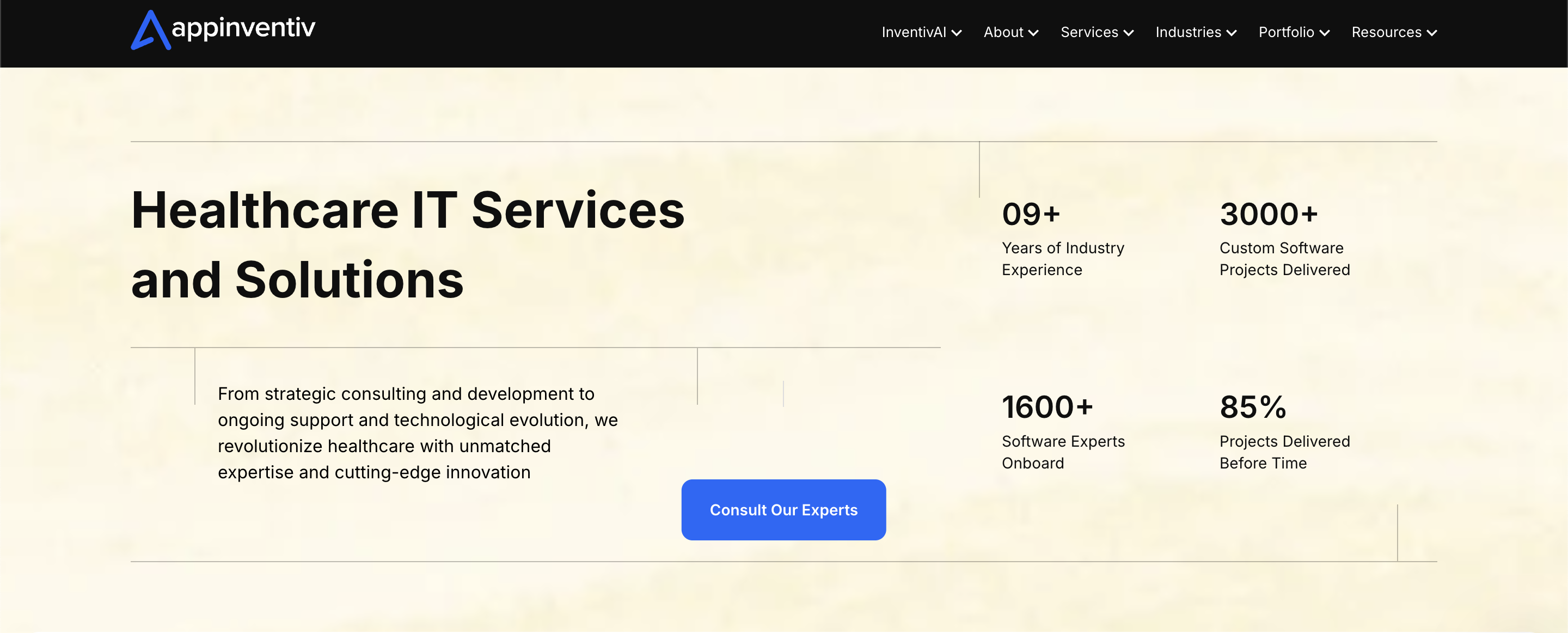
5. Appinventiv: Enterprise scale with proven wearable delivery
Headquarters: Noida, India (offices in USA, UK, UAE, Australia)
Company Size: 1,500+ employees | Founded: 2014
Core Services: Healthcare mobile app development, wearable app development, telemedicine platforms, AI/ML healthcare solutions, and IoT connected device applications at enterprise scale.
Wearable Integration Expertise:
Appinventiv has twenty-five completed wearable projects across Apple HealthKit, Google Fit, Samsung Health, Apple Watch, Android Wear, smart rings, and smart apparels. Implements HL7, FHIR, DICOM, and XDS standards for clinical interoperability.
Notable HealthTech Projects:
- DiabeticU: AI-powered diabetes management with wearable integration
- Soniphi: Personal wellness app using vocal biomarkers for diagnostics.
- YouCOMM: Hospital communication platform
Recognition: Deloitte Technology Fast 50 winner (2023, 2024). Times Business Awards Tech Company of the Year 2023.
Why They Made This List: Scale matters for large healthcare organizations rolling out wearable integration across multiple product lines, geographies, or patient populations. Global presence enables rapid staffing, multiple time zones, and simultaneous workstreams.
Best Fit For: Large healthcare organizations, multi-market deployments, organizations needing significant development bandwidth. May feel too process-heavy for small startups.
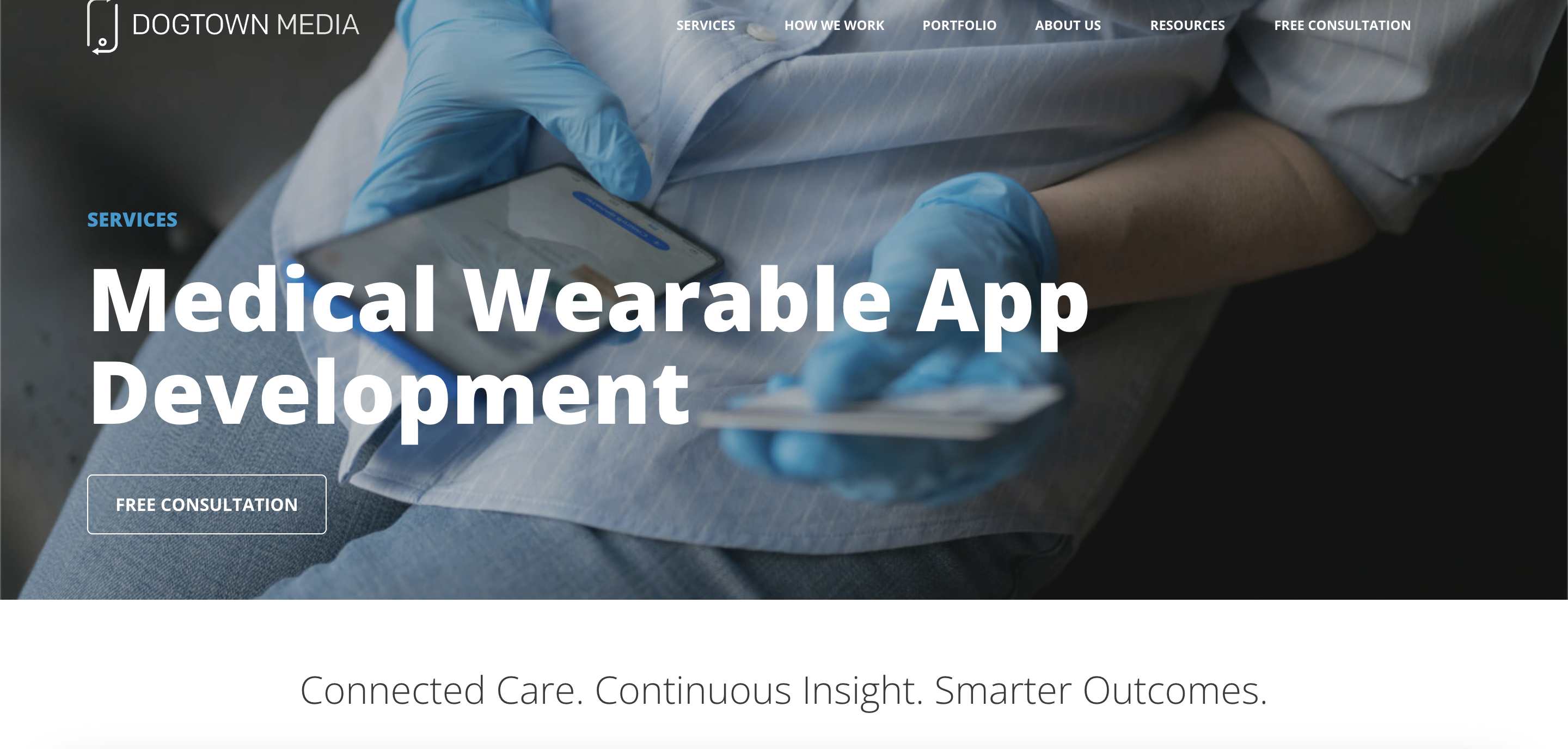
6. Dogtown Media: mHealth pioneer with proprietary device expertise
Headquarters: Venice Beach, California, USA
Company Size: Boutique agency | Founded: 2011
Core Services: mHealth app development, FDA 510(k) pathway support for medical device software, remote patient monitoring, healthcare IoT solutions, and HIPAA-compliant development.
Wearable Integration Expertise:
Widest proprietary SDK coverage including Oura, Whoop, Garmin, Fitbit, Omron HeartGuide, smart textiles, and FDA-cleared medical wearables. Their work with proprietary device SDKs (not just public APIs) shows relationships with device manufacturers and access to deeper integration capabilities.
Notable HealthTech Projects:
- Minneapolis Heart Institute: Cardiovascular emergency protocols application for clinical use.
- National Sleep Foundation: Sleep health study application
- Google (Train Up app), Harvard Medical School, United Nations, Biotronik
Recognition: Regulatory pathway expertise for Class I, II, and III medical devices with ISO 13485-aligned design controls. Named Top Wearable App Developer 2020.
Why They Made This List: Proprietary SDK expertise and FDA pathway support. Most agencies can integrate HealthKit and Google Fit. Those are well-documented public APIs. Dogtown Media's access to proprietary device SDKs represents relationships and technical depth boutique shops typically can't replicate.
Best Fit For: Medical device companies needing FDA-compliant companion apps, products integrating proprietary wearable SDKs, startups pursuing regulatory clearance.
7. Intellectsoft: Fortune 500 enterprise healthcare partner
Headquarters: Palo Alto, California, USA (global offices)
Company Size: 400+ employees | Founded: 2007
Core Services: Enterprise healthcare IT solutions, EHR/EMR systems, telemedicine platforms, practice management software, and IoT healthcare solutions. Digital transformation partner for large healthcare organizations.
Wearable Integration Expertise:
Wearable technology integration for hospital IoT ecosystems, real-time health monitoring via portable devices, RFID asset management systems, and cloud-based health data processing. Focus skews toward institutional deployments rather than consumer apps.
Notable HealthTech Projects:
- XMED: Mobile ecosystem that helps users diagnose health issues using AI and social networking.
- Knee Pads: Software reporting data from smart devices designed to collect pressure and time data
- Transplant Hero: Interactive alarm system that notifies its users when it is time to take their medication
Recognition: ISO 27001 certified with deep Fortune 500 client relationships. Named to Business of Apps Top Development Companies 2025.
Why They Made This List: Enterprise scale and institutional trust. If you're a large provider organization, health system, or established healthcare company integrating wearables into existing enterprise infrastructure, you need a partner who understands hospital IT departments and multi-year roadmaps.
Best Fit For: Large healthcare organizations, hospital systems, enterprises integrating wearables into existing clinical infrastructure. Not optimized for startups needing rapid validation.
Key Criteria for Selecting a Mobile Health App Development Company
Evaluating wearable-ready health app partners requires looking beyond generic development capabilities:
Technical Expertise
- Platform proficiency: HealthKit (iOS), Health Connect (Android), Samsung Health
- Device connectivity: Bluetooth LE, proprietary SDKs, medical-grade sensors
- Data interoperability: FHIR, HL7, DICOM standards for clinical integration
- Cross-platform frameworks: Flutter, React Native for unified codebases
Healthcare Domain Knowledge
- Regulatory compliance: HIPAA, FDA, GDPR, ISO 13485 certifications
- Clinical workflows: Understanding provider needs beyond technical requirements
- Medical device experience: Class I/II/III pathways and documentation
- EHR integration: Epic, Athena, Cerner connectivity patterns
Wearable-Specific Capabilities
- Data normalization: Converting inconsistent device outputs to standardized formats
- Multi-vendor ecosystems: Supporting a wide range of devices without vendor lock-in
- Open source contributions: Demonstrated infrastructure leadership
- Production deployments: Verified projects handling real patient data
Partnership Considerations
- Healthcare exclusivity: Agencies focused solely on health vs. general digital work
- Transparent pricing: Clear cost structures without hidden fees
- Client references: Verifiable case studies with measurable outcomes
- Ongoing support: Post-launch maintenance and scaling capabilities
The Google Fit API Migration: What Already Happened
Deadline that already passed: Google Fit APIs stopped working on June 30, 2025. Any Android app still using Fit lost all wearable functionality completely, and had to migrate to Health Connect.
That migration was an architectural change, not a simple API swap, affecting:
- Permission models and user consent flows
- Data schemas and query patterns
- Background sync and battery optimization
- Manufacturer-specific Health Connect implementations
Apps that kept using Fit APIs after the deadline broke completely, losing access to steps, heart rate, sleep, and all health metrics. Experienced wearables development companies understand Android fragmentation and manufacturer variations in Health Connect adoption today.
What this means for your project:
- Confirm your Android integration runs on Health Connect, not the retired Fit APIs
- Test across multiple Android manufacturers (Samsung, Google, OnePlus)
- Update privacy policies and user consent mechanisms
- Verify data continuity during migration for existing users
Wearable Data Integration: Beyond Simple API Calls
Professional wearable integration encompasses far more than connecting to HealthKit:
Data Normalization Challenges
Raw wearable data arrives in inconsistent formats. Heart rate from Apple Watch uses different structures than Garmin or Whoop. Without normalization, devices can't be compared, clinical algorithms break when users switch devices, AI models fail across vendors, and EHR integration becomes impossible.
Multi-Device Support
Users don't stick with one wearable forever. Your health platform must handle:
- Device switching mid-program without data loss
- Simultaneous data from multiple devices (fitness tracker + CGM)
- Historical data migration when users upgrade devices
- Graceful degradation when specific metrics unavailable
Clinical Context
Consumer wearable data requires clinical interpretation:
- Sleep "score" doesn't map directly to clinical sleep disorders
- Heart rate variability needs context (resting vs. active, time of day)
- Step counts require adjustment for gait impairments
- Calorie estimates vary 20-30% between devices
Infrastructure Requirements
Production wearable platforms need:
- Real-time data ingestion pipelines handling millions of daily data points
- HIPAA-compliant storage with audit logging and encryption
- Anomaly detection flagging device errors vs. clinical events
- Offline-first mobile architecture synchronizing when connectivity restored
Conclusion: Infrastructure, Not Features
Wearable integration is infrastructure work, not feature development. The companies worth partnering with understand data pipelines, normalization challenges, clinical context, regulatory requirements, and operational realities of maintaining wearable-connected systems at scale.
This list prioritizes delivery competence over marketing claims. We selected partners who've shipped production systems, navigated regulatory pathways, and built infrastructure that stands up under real-world use.
Whether you're a startup validating product-market fit or an enterprise deploying at scale, one of these seven companies offers genuine capability in mobile health app development and wearable data integration that goes beyond basic API calls.
The field keeps evolving with the Google Fit sunset behind us, proprietary device proliferation, AI integration opportunities, and regulatory changes meaning wearable integration requirements keep shifting year over year. The best partners are already building for that future, contributing to open-source infrastructure, publishing technical guides, and treating wearable integration as the strategic architectural decision it is.
Open Source Option: Build Your Own Integration Layer
If you're evaluating development partners, it's worth knowing that one option on this list - Momentum -also maintains an open-source wearable integration
platform you can use independently. Open Wearables connects Apple HealthKit, Garmin, Oura, Whoop, Fitbit, Strava, and a growing set of other providers through a single normalized API. MIT-licensed and actively maintained. It's not a replacement for a development partner if you need full-stack build support but if your team can handle the integration work and needs a solid open-source foundation, it's worth evaluating before committing to a proprietary solution.
See Open Wearables on GitHub
Open Wearables docs



.avif)
.avif)
.avif)

