
FDA: How Medical Devices Are Certified in the US?
A recorded session for teams taking a medical device or health software to the US. It compares the FDA route with MDR and goes through the pathways to clearance. It closes with the CMS ACCESS model for products reaching Medicare patients.
What You'll Learn About FDA Certification
Context and What We Already Know
The US has one regulator for medical devices, while each state works like a separate healthcare market with its own key players. Manufacturers submit directly to FDA, with no notified body in between. The session also covers how FDA treats companies from outside the US. Applying requires a US entity. Most foreign companies work with an FDA consultant who knows the agency's language.
FDA vs MDR
FDA relies on ANSI/AAMI standards, which are moving closer to ISO over time. It also uses its own device classes, so a single Class II covers what MDR splits into IIa and IIb. Guidance documents change often. Under the 2023 cybersecurity guidance, a submission without a machine-readable SBOM can be refused before the review starts. The session shows how to find your class through the FDA product code database, starting from a precise intended use.
Pathways and Costs
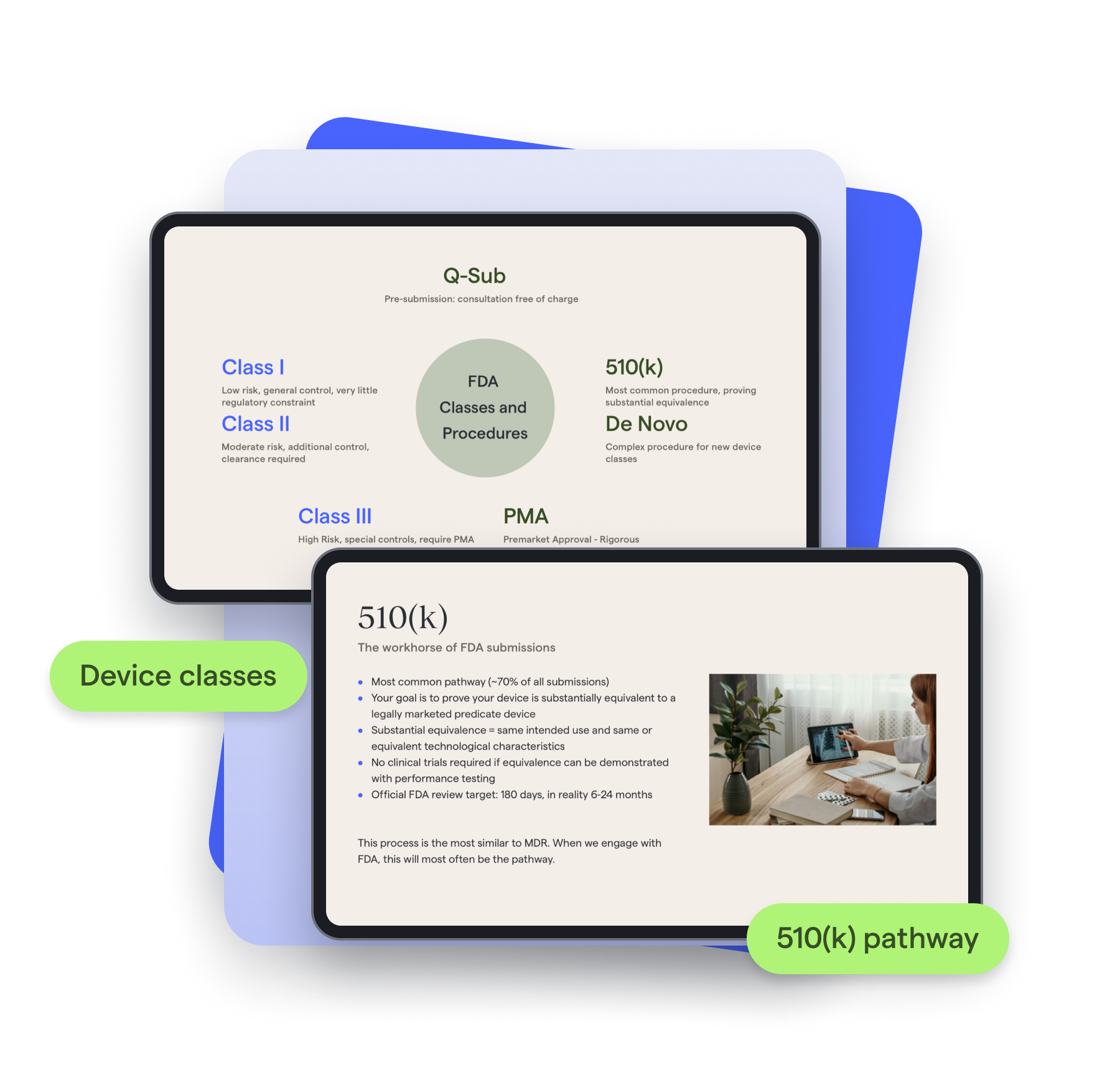
The session compares Q-Sub, 510(k), De Novo and PMA and explains when each one applies. About 70% of submissions go through 510(k), which has an official review target of 180 days and in practice takes 6 to 24 months. You will see where the cost of a submission comes from and what an additional information request does to the review clock. The section also covers third-party review and Predetermined Change Control Plans for AI/ML devices. It ends with the criteria that keep clinical decision support software outside device oversight.
CMS Access
The last part explains the CMS ACCESS model for Medicare beneficiaries. Part of the payment arrives at the start and the rest depends on whether the patient improves. The session goes through what participation looks like in practice, from reporting to the responsible physician to the eligibility questions that were still open at launch.
Built for Teams Taking Medical Software to the US
Teams with a CE mark or an MDR process in place who are planning to enter the US market.
Founders and product leads deciding whether their product is a medical device or a general wellness product.
Engineering teams building AI/ML features that will keep changing after clearance.
Health tech companies looking at Medicare as a route to US patients through the CMS ACCESS model.
Where This Comes From
Momentum is a healthtech software company. We have been building health applications since 2016 and hold ISO 13485 certification. Our business analysis team works through regulatory requirements like these with clients before a build starts.
At the discovery stage, our product and design team turns those requirements into a product plan.
More from the BA EDU Series
.avif)
FDA Certification FAQ
What are the FDA medical device classes?
FDA sorts medical devices into three classes by risk. Class I covers low-risk products such as bandages; around half of them are exempt from premarket submission. Class II covers moderate-risk devices, including most digital health software. These need clearance before entering the market. Class III covers devices that sustain or support life, such as pacemakers. They require Premarket Approval.
How do I find out which FDA class my device is in?
Your FDA class follows from your device's product code, which you find by defining the intended use precisely and searching the FDA Product Classification Database. Each three-letter code gives the class and the regulation number. It also shows whether the device needs a 510(k). If nothing matches, a 513(g) request asks FDA directly and gets a written answer in about 90 days.
What is a 510(k)?
A 510(k) is a premarket submission showing that a device is substantially equivalent to a predicate, a device already legally on the US market. Substantial equivalence means the same intended use and the same or equivalent technological characteristics. It is the most common pathway, used for about 70% of submissions. No clinical trial is needed when performance testing can demonstrate equivalence.
How long does FDA 510(k) clearance take?
FDA's official review target for a 510(k) is 180 days. In practice clearance takes 6 to 24 months. One reason is the additional information request: when a reviewer sends one, the review clock stops until the submitter responds.
What is the difference between 510(k) and De Novo?
A 510(k) relies on an existing predicate device, while De Novo is for Class I or II devices with no predicate. De Novo is more complex and takes about twice as long. Once granted, it creates a new device classification that later products can use as their predicate.
What is a Q-Sub?
A Q-Submission (pre-submission) is a formal request for FDA feedback before you file. FDA answers in writing. Teams use it to confirm classification, testing requirements, predicate strategy and intended use wording. The answer carries weight in practice even though it is not binding.
Is a wearable a medical device under FDA rules?
A wearable with health features can fall under general wellness rules rather than medical device rules, depending on its intended use and the claims made about it. The line is less clearly drawn than under MDR, though the two mostly align. FDA's January 2026 guidance relaxed oversight of low-risk general wellness products and of some wearables with health features.
Does clinical decision support software need FDA clearance?
Clinical decision support software stays outside FDA device oversight when it meets all four criteria. 1. It does not acquire or analyze medical images or signals from diagnostic devices. 2. It displays or analyzes medical information about patients. 3. It gives recommendations, not directives, to support a clinician's decision. 4. It lets the clinician review the basis for each recommendation independently. Drug interaction alerts and preventive care reminders are typical exempt examples. Software that analyzes CT images or ECG waveforms stays regulated.
What is a PCCP?
A Predetermined Change Control Plan (PCCP) lets the manufacturer of an AI/ML device declare in advance which model changes it plans and how it will validate them. FDA approves the plan upfront, so retraining within its scope does not need a new submission.
What is the CMS ACCESS model?
The CMS ACCESS model is a Medicare payment model for care delivered with digital health technology. Part of the payment arrives at the start and the rest depends on whether the patient improves. Participants also send information to the patient's responsible physician.
Can a company from outside the US apply for FDA clearance?
A company from outside the US can apply for FDA clearance through a US entity, which is required for the application. Foreign companies can face stricter treatment and most work with an FDA consultant. EU companies are usually advised to apply once the product is mature.
How current is the information in the session?
The session was recorded in July 2026. FDA guidance and the CMS ACCESS details change often, so check the current FDA and CMS sources before you file.
How do I watch the session?
Sign up with the form on this page and the link to the recording arrives by email right away. You can watch it whenever it suits you.
Is this regulatory advice?
The session is educational material for product and engineering teams. For decisions specific to your product, check with a regulatory consultant.