
Health Scores: How Sleep Gets Measured and Scored
A neuroscientist walks through what a wearable can detect overnight and how accurate those measurements are compared to direct recording of brain activity. She also covers what goes into turning them into a score.
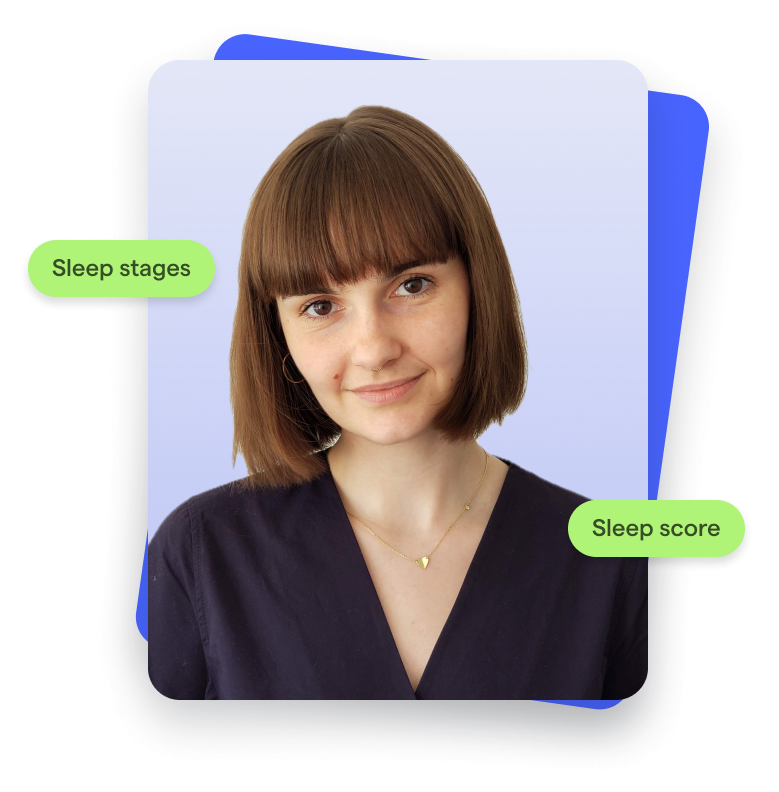
What You'll Learn About Sleep Measurement and Scoring
What Good Sleep Looks Like
Sleep science describes a night through five measures: duration, sleep latency, number of awakenings, wake after sleep onset and sleep efficiency. Anna explains the healthy range for each one and how recommended sleep duration changes with age.
How Sleep Gets Measured
Polysomnography records EEG, EOG, EMG and ECG directly. A wrist wearable relies on accelerometry and photoplethysmography. Anna shows what each approach can see.
How Accurate Wearables Are
Anna compares how well ten devices detect sleep and wakefulness (sensitivity and specificity) and how closely their sleep staging matches polysomnography, with the validation study behind each figure. Detection of sleep itself comes close to direct recording, while wakefulness and sleep stages carry much more uncertainty.
What Goes Into a Sleep Score
Apple, Oura, Garmin, Whoop and Fitbit each account for a different set of parameters, from duration and stages to timing, efficiency, latency, awakenings and restfulness. Anna puts them side by side based on what each provider states publicly about its own inputs. The formulas themselves are not published, which is part of why the same night can come back as different numbers.
How We Approach Building a Score
Our health science team follows four steps. It reviews the scientific literature behind each metric and checks how accurately wearables detect it. Then it designs the algorithm and tests it in iterations. Anna closes with the sleep score in Open Wearables, built with this method.
Built for Teams Working with Wearable Data
Product teams shipping sleep or recovery features and deciding what to show users.
Engineers integrating wearable APIs who want to understand what the numbers coming back represent.
Founders building health products where sleep data drives the core experience.
Anyone curious about how a wrist sensor gets from accelerometry and photoplethysmography to a number on a screen.
Who's Presenting

Anna Zych, PhD
Neuroscientist, Health Science Lead at Momentum
Anna designs and validates the health scoring models at Momentum. She writes The Science Behind Wearables, a newsletter on what wearable sensors can measure, based on validation research.
Where This Comes From
Momentum is a healthtech software company. We have been building health applications since 2016. Our team pairs engineers who build wearable apps daily with a health science team that designs scoring models.
We also built Open Wearables, an open-source platform that brings wearable data from different devices into one normalized API. In the session, Anna shows how its sleep score is built.
Sleep Measurement FAQ
How do wearables measure sleep?
Wearables estimate sleep from accelerometry and photoplethysmography. Polysomnography records EEG, EOG, EMG and ECG directly, while a wrist device relies on these two sensing methods. Every number a wearable reports about sleep is an estimate built on that data.
How accurate are wearable sleep trackers?
Sleep sensitivity is above 90% across devices, so wearables detect sleep itself well. Detecting wakefulness is harder, which makes reported sleep look longer and more efficient than it was. Sleep stage classification sits around 60 to 80% agreement with polysomnography and varies by stage and by device.
What is sleep efficiency?
Sleep efficiency is the share of time in bed that you spend asleep, expressed as a percentage. Research puts a healthy range at roughly 84 to 100%. Sleep science uses it alongside duration, latency, awakenings and wake after sleep onset to describe a night.
What is sleep latency?
Sleep latency is how long it takes you to fall asleep after going to bed. The recommended time is under 30 minutes. Polysomnography measures it directly and wearables estimate it from accelerometry and photoplethysmography.
What is wake after sleep onset?
Wake after sleep onset is the total time spent awake during the night after you first fall asleep. Under 20 minutes is the usual reference point. Wearables find it one of the hardest measures to get right, because detecting wakefulness is harder than detecting sleep.
What does Apple, Oura, Fitbit, Garmin or Whoop count in a sleep score?
Each provider publishes which parameters feed into its sleep score. The lists vary from sleep stages and timing consistency to efficiency, latency, awakenings or restfulness. The formula that turns those inputs into a number is not published, so two devices can report the same night differently even when their measurements are close.
Why do two devices report different numbers for the same night?
Two devices measure differently and weigh different things. A wrist sensor estimates sleep from accelerometry and photoplethysmography, so two devices can disagree about when sleep started or which stage you were in before any scoring happens on top.
Is it live?
The session is pre-recorded and premieres at the scheduled time. Sign up and we will send you the link.
What if I can't make the premiere?
Register anyway. The recording stays available afterwards and you will get the link.
Do I need a technical background?
No. Anna explains the sleep science from the ground up, for product and engineering teams.